Now in TürkiyeLaunch offer: every plan discounted, the activity box as a gift
See Better.Together.
Dichoptix is a system of engaging games and camera-based technology that helps children use both eyes together.
- Grounded in evidence
- Private by design
- Built with eye doctors
 Launch gift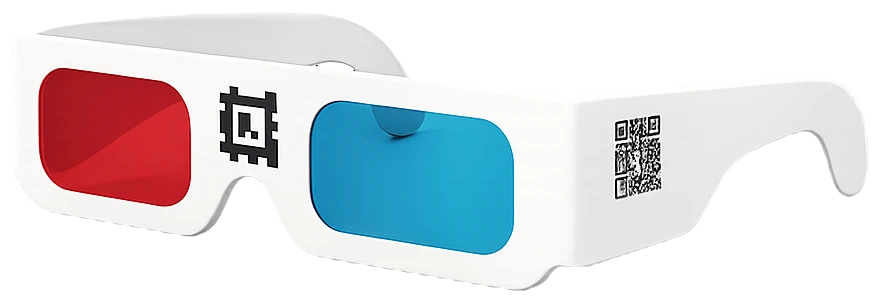
Activity box
A gift with every plan during the Türkiye launch
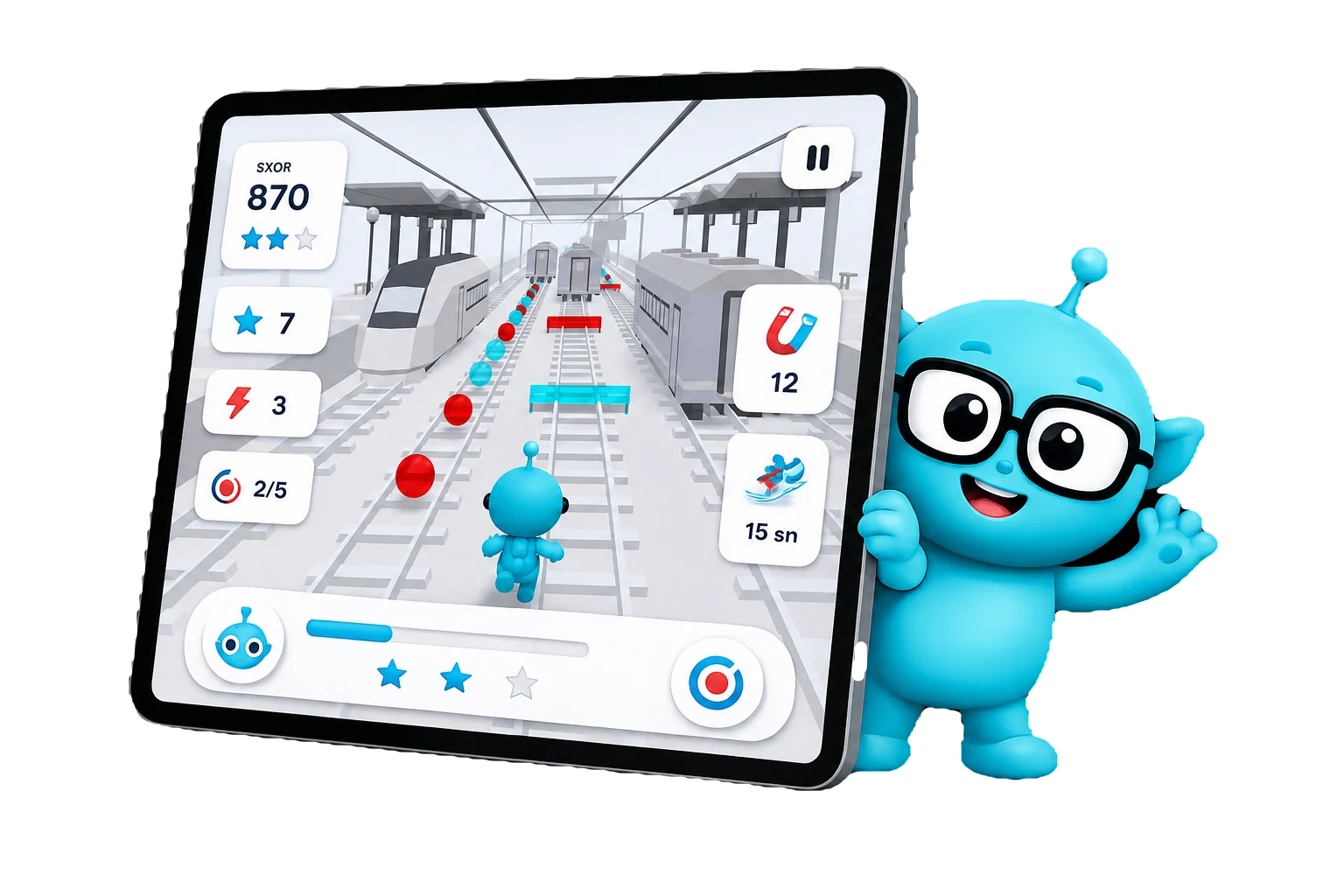
Games worth playing
Dichoptic games that make every session something a child comes back to.
Camera-based check
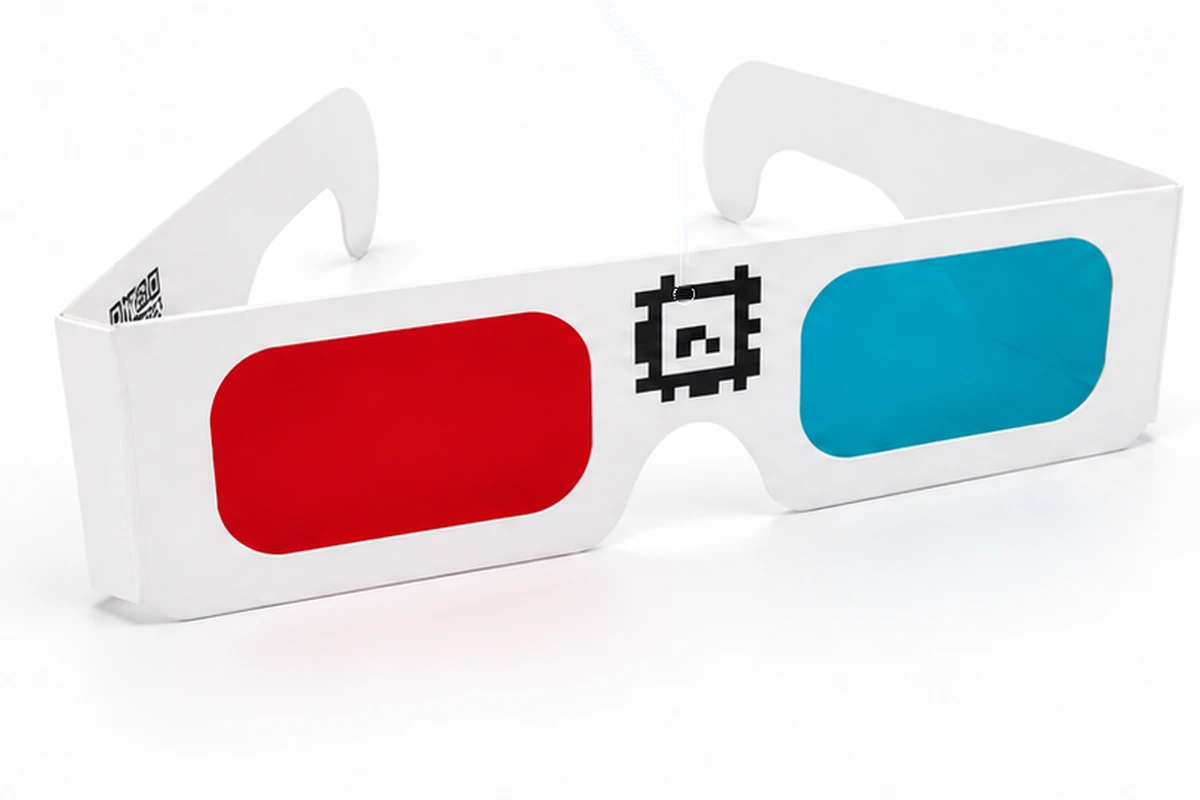
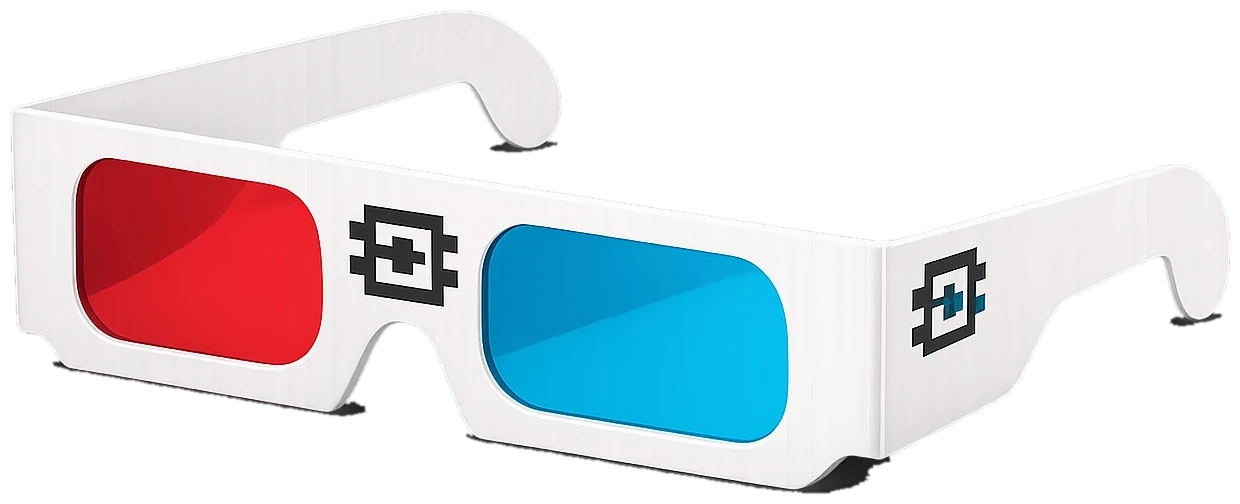
A marker on the glasses lets the tablet confirm they are being worn.
Kept on record
When each session happened and how long it lasted, week by week.
Better together
Family, child and clinician working towards the same goal.
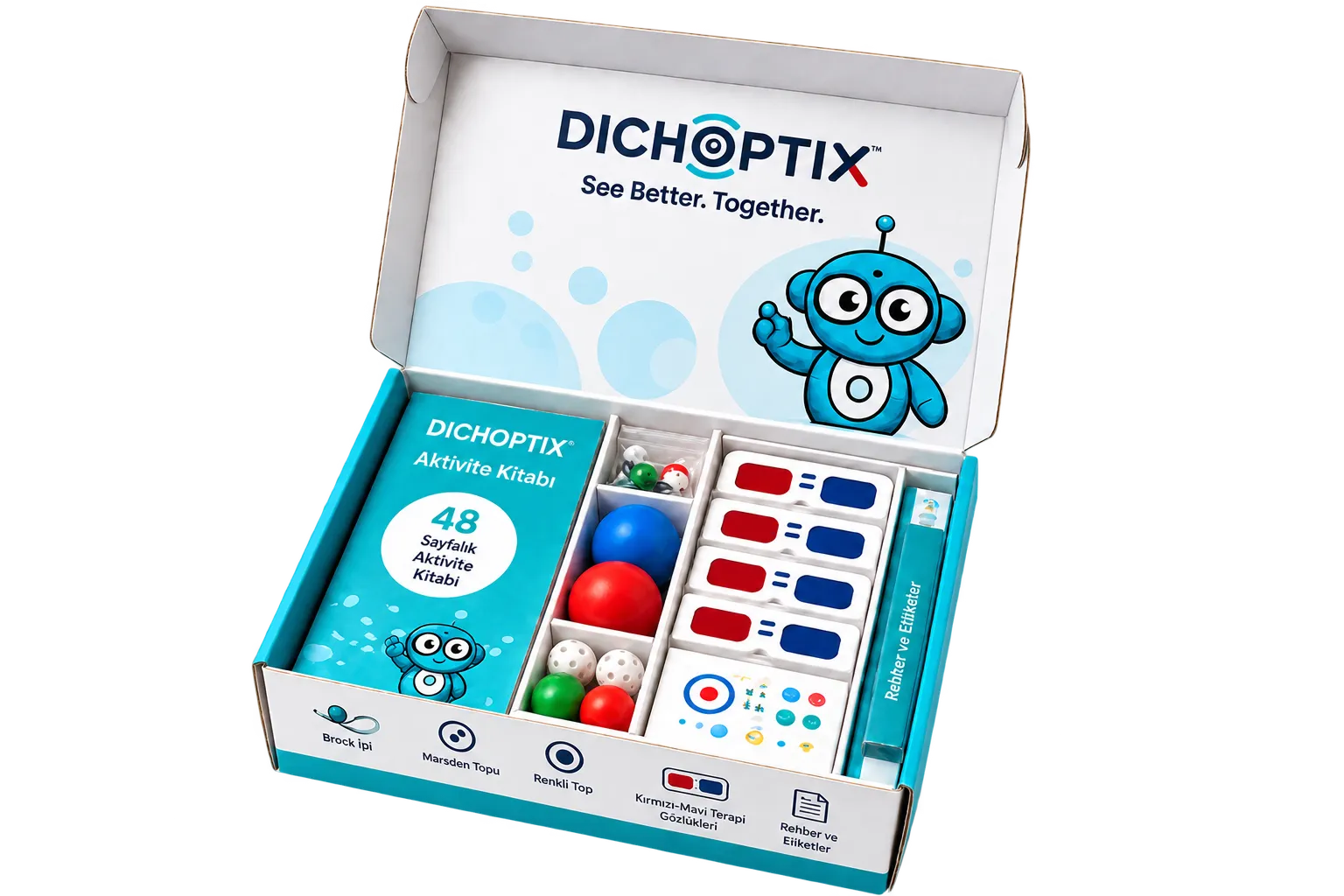
The fun spills off the screen with the activity box.
Play starts on the screen and carries on at the table. During the Türkiye launch, the box is a gift with every plan.
Play one right here
A taste of the idea, not the therapy itself. The real program lives in the app.
Never a dull day
Therapy takes months, so boredom is the real enemy. Dichoptix is a whole library of bright, playful games across lots of styles, with new ones added regularly, so there is always a reason to come back tomorrow.
New games added regularly, and every one trains both eyes.
The whole library lives in the app.


A daily habit that fits a child's life
Effective amblyopia therapy is mostly about consistency. Your doctor sets the daily dose; our job is to make it a session a child will keep for months, not days.
- 1
Set up with a quick check
Tell us which eye to train and your clinician's plan. Setup takes a couple of minutes, with no special equipment to figure out.
- 2
Play a little, every day
Every session trains both eyes together. The difficulty adapts to your child, so the game holds until the time your doctor set is done.
- 3
Watch the record add up
Every session is logged with its time and length, for you and, with your consent, for the eye-care professional supervising the treatment.
A dichoptic session only counts while the glasses are on
A session log proves the app was running. It does not prove the glasses were on, and without them there is no dichoptic separation at all: the child is simply playing a game. A marker on the frame lets the tablet camera check, so the minutes recorded are minutes of treatment.
- 1A printed marker sits on the bridge of the therapy glasses.
- 2During play, the tablet's front camera checks whether the marker is in view.
- 3If the glasses come off, the session pauses and the clock stops.
The camera check runs entirely on the device. No image, frame or video is stored, and none is sent to us or to anyone else. What leaves the device is a single fact: whether the glasses were on.

Verified use with PatchCode
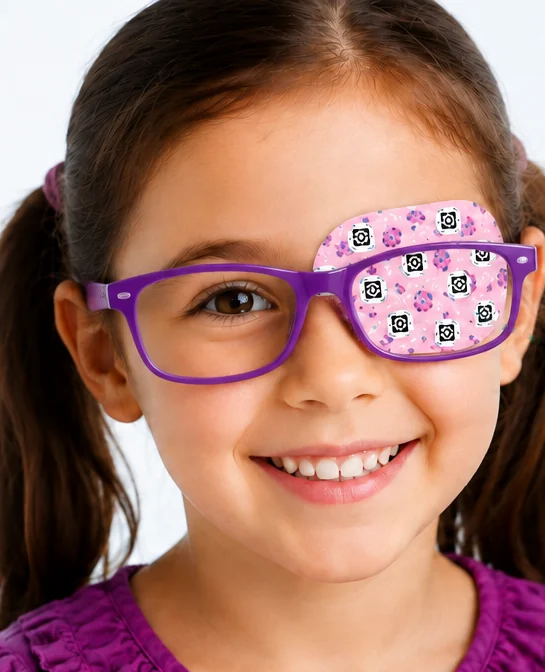
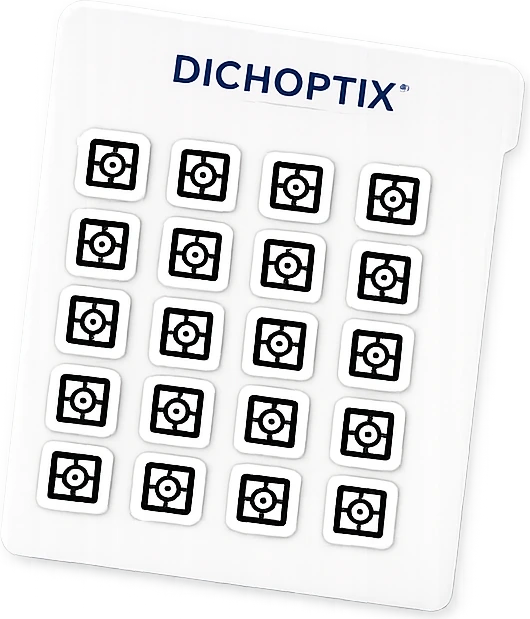
Occlusion is one of the cornerstones of amblyopia treatment and it complements binocular work. Whichever your doctor prescribed, or both, that is the plan. The code on the patch is read by the tablet's camera. The app sees that the patch is on and which eye it is on. The record is kept for that time only.
You also keep your own patch. PatchCode works with any of them, so a child who has finally accepted one particular patch never has to give it up.
 Dichoptic modeSingle eye mode
The switch happens on its own, the moment the sticker is recognised.
- 1Stick one PatchCode on the patch you already use.
- 2Put the patch on and start the session as usual.
- 3The camera reads the sticker and confirms the patch is on and which eye it covers.
- 4The game switches to full colour for single eye work. Only verified minutes count towards the occlusion time, and if the patch comes off the clock stops.
- 5If the patch is on the wrong eye, the app says so.
Your doctor sets the treatment plan. Our job is to keep an honest record of how much of it happens at home, and to put that record in your doctor's hands.
The check runs entirely on the device. No image, frame or video is kept or sent, not to us and not to anyone else. The only thing that leaves the device is this: was the patch on, on which eye, and for how long.
Therapy starts on the screen and carries on at the table
Screen sessions are the core of the programme, but they are not all of it. The activity box holds the classic orthoptic tools, the ones eye clinics have used for decades, so the work continues away from the tablet: a few minutes at the kitchen table, together, on days when nobody wants another screen.
A launch gift, not a product
The box cannot be bought separately and it is not needed to begin. During the Türkiye launch it ships free with every plan, together with the red-blue therapy glasses.
- 48-page activity book
- Brock string
- Marsden ball
- Coloured ball
- Red and blue therapy glasses
- Guide and stickers
- 48-page activity book
- Brock string
- Marsden ball
- Coloured ball
- Red and blue therapy glasses
- Guide and stickers
Serious therapy. Genuinely fun.
Everything is built around one idea: a child who enjoys the therapy actually finishes it, and the results follow.
Binocular by design
Anti-suppression training that works both eyes together to rebuild depth perception, not just patch the strong one.
Actually enjoyable
Real games with characters, rewards, and variety, engineered so kids ask to play, not to quit.
Adapts to your child
Difficulty tunes itself to each child's performance, keeping every session in the sweet spot between too easy and too hard.
Kept on record
Time used and how regularly, week by week, so you can show your doctor what was actually done.
Built with doctors
Designed alongside ophthalmologists and orthoptists, grounded in published binocular-vision science.
Private by default
Your child's data is shared with a supervisor only with your explicit, revocable consent. Always.
We don't give boredom a chance
We are a game company. We watch where children put a game down, which stage loses their attention, the moment they drift off the screen, and then we redesign those moments. It is not common practice in therapy apps. It is ordinary practice in game studios.
Neither half is enough on its own. Without the clinical staircase it is a pleasant game that treats nothing; without the game craft it is correct treatment that a child abandons in ten minutes. The two run together: when the engagement signals drop, the contrast staircase steps back, and it moves on again once the child has found their feet.
Weak eye
Fellow eye
Together
Each eye is given different pieces and the task can only be completed when the two are put together: neither eye alone has enough to play with. The staircase works on that balance. The amblyopic eye is always shown at full strength, while the contrast given to the fellow eye opens a step after successes and closes a step after a miss. With the patch there is no second eye to balance, so the same method runs on the difficulty of the task instead.
We find the drop-off points
Which game holds attention and for how long, where children stop, which stage loses them. Every release goes back to those points.
The clinical staircase
The therapy side of it: the contrast given to the fellow eye opens a step after successes and closes one after a miss, holding the task right at the edge of what the child can do.
The session lasts as long as it needs to
A child's interest has to outlast the time your doctor set. Game order, reward pacing and difficulty are built around that.
If the child does not love the game, everything else stays theoretical.
Walk into the check-up with the record in hand
The examination is your doctor's job. Ours is to make sure you arrive with a real record of what happened at home: which days, how long, how regularly. No trying to remember.
Total time used
360min
This week
Days worked
6 / 7
This week
Verified use
90%
Share of time verified
Why a verified record?
The literature commonly prescribes two hours of patching a day for moderate amblyopia. Objectively monitored trials find children receive around half of what is prescribed: an average of 4.2 hours a day in a group prescribed six. The minutes in the record are the minutes the code was read and the patch was actually on.
Repka MX et al., Arch Ophthalmol 2003Stewart CE et al., BMJ 2007
Records the time actually used
Verifies it while the code is being read
Shows how much of the target was reached
Says so when the patch is on the wrong eye
Your doctor sets the target time. Dichoptix records how much of it was reached.
Built on science, shaped by clinicians
Amblyopia is a medical condition, and we treat that responsibility seriously, both in how we design the therapy and in how honestly we talk about it.
Grounded in binocular-vision science
Built on the anti-suppression approach to amblyopia, training both eyes together to reduce how the stronger eye suppresses the weaker one.
Shaped by clinicians
Our exercises and metrics are designed with practicing eye-care professionals, not retrofitted to a game.
Honest about what we are
We're a therapy-support tool used alongside professional care. We'll always be clear about evidence and never overstate it.
We're a therapy-support tool used alongside professional eye care, not a replacement for it, and not a medical device. We'll always tell you what the evidence does and doesn't show.
Supervise treatment without the busywork
Stay in the loop on the patients you care for. With the family's consent, you can see the record of exercise done between visits, and revisit the plan when it matters.
- See time used and regularity remotely
- Access is consent-based and fully auditable
- Recommend it as structured therapy homework
Plans that fit your family
Nothing to buy before you start: your therapy glasses ship for free, and you can cancel anytime.
Good things to know
The essentials parents ask most. Can't find your answer? We're happy to help.
What is amblyopia (lazy eye)?
Vision in one eye that did not develop fully in childhood. The brain learns to favour the stronger eye, and the weaker one falls behind.
Does this replace my eye doctor?
No. Diagnosis, the treatment plan and follow-up belong to your eye-care provider. We help you carry that plan out at home.
Does the app test my child's vision?
No. Measuring vision belongs to the examination. We record when the exercise happened and how long it lasted.
How does the therapy work?
Your child plays dichoptic games in red-blue glasses. Each eye receives a different part of the scene, so the task only works when both take part.
What does the camera do?
It reads the code on the glasses or the patch and confirms they are on. The check runs on the device, and no image is stored or sent.
What is PatchCode?
A coded sticker you place on the eye patch you already use. When the camera reads it, the patching time is recorded as verified.
We patch rather than use glasses. Is this for us?
Yes. PatchCode works with any eye patch, and while the patch is on, the game switches to full colour.
What if the patch goes on the wrong eye?
The app notices. Where the code sits shows which eye is covered.
How much time does it take each day?
Your doctor sets the daily dose; in the literature it usually sits around an hour. Keeping the habit counts as much as the length of any single day.
What if my child gets bored?
That is what the game library is for. Difficulty adapts to your child, and switching titles keeps attention alive through the session.
Do I have to buy anything to start?
No. Your therapy glasses ship free, and you can cancel whenever you like.
What is the activity box, and is it sold separately?
A box of classic orthoptic tools for work away from the screen. It is not sold separately: during the Türkiye launch it comes free with every plan.
Who can see my child's record?
You always can. A clinician can only if you explicitly grant consent, and you can revoke that at any time.
Can we delete our data?
Yes. Deleting your account also deletes the therapy record attached to it.
Give the daily eye workout a reason to look forward to
Get started today. See how your child takes to it before you decide anything.