Crowding: one letter is readable, a row of them is not
Published: July 27, 2026
In short
What distinguishes an amblyopic eye is not that everything looks blurred but that objects run into each other when placed side by side. The same child can read a letter shown alone and fail to read that letter inside a row. This is why measurement with linear optotypes matters: a single-letter test can make the vision look better than it is.
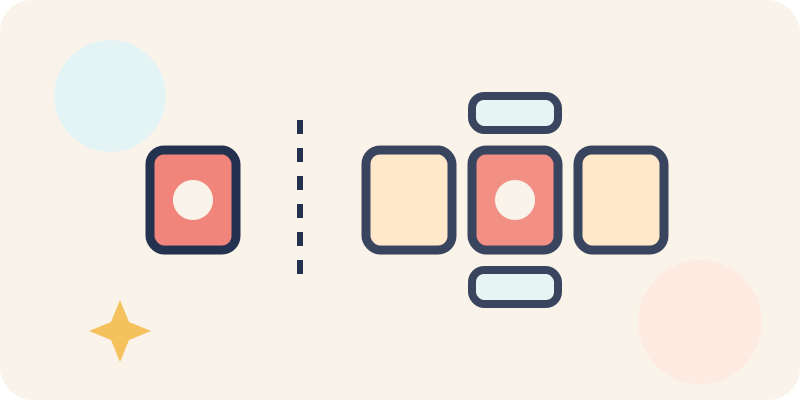
Lazy eye is usually described as "that eye sees blurred". The description is incomplete. The most distinctive feature of an amblyopic eye is its difficulty recognising objects in company rather than in isolation.
The phenomenon is called crowding. It exists in healthy vision too, but in amblyopia it grows markedly, and it shapes everything from the eye test to reading speed.
The same letter, two different results
A familiar scene plays out at appointments: the child reads a letter shown alone without difficulty, then cannot read the same letter placed in the middle of a row. The letter did not change. Its neighbours arrived.
In amblyopia that gap is large. Acuity measured with a single optotype can come out noticeably better than acuity measured with a row.
The practical consequence is that a single-letter test can flatter a child with amblyopia. This is why charts present letters in lines, or draw a box around the target.
What the brain is doing
When the visual system recognises a letter it processes not only that letter's edges but the information around it. Detail within a region is pooled together, and if neighbouring objects sit close enough their features mix with the target's.
That pooling region is larger in an amblyopic eye. In other words, the weaker eye needs more empty space around a letter to separate it from its neighbours.
This is different from a blur that glasses can correct. Crowding is a processing limit, not an optical one: the problem lies not in the sharpness of the image on the retina but in how that image is resolved.
The link with reading
Reading is where crowding is felt most. Letters sit next to each other and lines stack above and below, so text is crowded by its very nature.
A child whose chart acuity looks fine can therefore still read slowly, skip lines or tire early during near work. Families often read this as an attention problem.
Letter spacing and print size affect this directly. The same child may read a widely spaced text noticeably more comfortably.
What it means for measurement and treatment
Crowding is the clearest evidence that amblyopia is not simply a loss of acuity. Watching a single number over time can therefore mislead, and the same child giving different results on different test formats is expected rather than odd.
In visual tasks, the density of distractors around a target is a natural part of difficulty setting: tightening the spacing makes a task harder without shrinking the letter. In dichoptic programs this is one axis available for fine-tuning difficulty while both eyes work together.
Terms used here
- Crowding
- The difficulty of recognising a target when other objects surround it. It is markedly stronger in amblyopia.
- Single optotype
- A letter or symbol presented alone on the chart. With nothing beside it, crowding does not come into play.
- Linear optotypes
- Letters presented together as a row. In amblyopia this reflects real performance more accurately than a single symbol does.