Contrast sensitivity: the vision the chart does not measure
Published: July 27, 2026
In short
Visual acuity measures how small a high-contrast letter you can resolve. Contrast sensitivity asks a different question: how distinct does an object have to be before you can separate it from its background? In an amblyopic eye this sensitivity is often reduced, and it does not always move in step with acuity. It matters doubly for dichoptic training, because that method works directly on this axis.
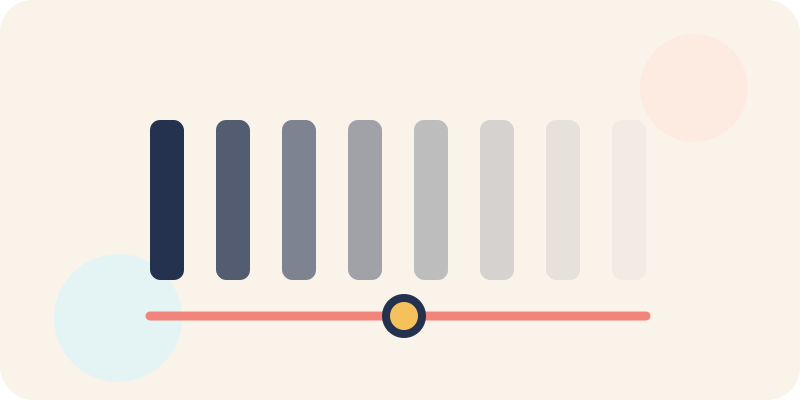
The number you take home from an appointment is measured with deep black letters on white. That is one aspect of vision: the finest detail you can resolve under the best possible conditions.
Daily life is rarely that crisp. A step at dusk, a sign in fog, faint print on light grey paper, a familiar face across a room: all of these are low-contrast tasks.
What contrast sensitivity is
Contrast is the difference in brightness between an object and its background. Contrast sensitivity tells you how small that difference can become before the object disappears, in other words how little difference you need in order to see it.
The measurement is not a single number. Different scales, from coarse patterns to fine detail, are tested separately and the result is a curve. Someone can do well on coarse detail and poorly on fine.
Contrast sensitivity is therefore not a replacement for acuity but a measure that sits alongside it.
What happens in amblyopia
Amblyopic eyes are often found to have reduced contrast sensitivity, and the reduction tends to be most pronounced in the fine-detail range.
The important point is that this measure does not always move in the same direction as acuity. A child can climb lines on the chart while still struggling with low-contrast tasks.
In daily life this shows up as the thing families notice but cannot name: more hesitation in dim light, slower going with faintly printed books, less confidence on overcast days.
How it is measured
The best-known method uses charts on which letters stay the same size while growing progressively fainter. The person reads down to the point where the letters can no longer be told apart, and the threshold is set there.
A second method uses patterns of light and dark stripes. Varying the fineness of the stripes and their contrast separately produces different points on the curve.
It is not measured routinely at every appointment. But when acuity has improved and the everyday complaint persists, this is precisely what the chart cannot show.
The axis dichoptic training works on
In amblyopia contrast is not only an outcome that gets measured. It is the control knob the dichoptic method uses.
In a system where suppression is present, presenting both images at equal contrast means the brain discards the weaker eye's. So in a dichoptic approach the contrast of the image going to the strong eye is lowered: the imbalance is reduced until the point where both images can be processed together.
As progress is made, that balance is drawn gradually back towards equality. Contrast is therefore both the dial the treatment is set by and the measure progress can be tracked on. The progress a line count on the chart cannot express on its own is often visible right here.
Terms used here
- Contrast sensitivity
- The smallest difference in brightness needed to tell an object from its background. The smaller the difference you can catch, the higher the sensitivity.
- Spatial frequency
- How fine the detail in a pattern is. Contrast sensitivity is not one number but a curve drawn across coarse to fine detail.
- Contrast balancing
- Setting the contrast of each eye's image separately in dichoptic training. The strong eye's contrast is lowered until the two images can be combined.