The critical period: the years vision is built in
Published: July 27, 2026
In short
The visual system does not arrive finished at birth; it is built during the first years according to the image it receives. The classic work of Wiesel and Hubel showed that depriving one eye during development permanently changes how cells in the visual cortex respond to that eye. This is why early treatment is easier. Yet reduced sensitivity is not a closed door: gains have been reported in adults as well.
Whenever lazy eye comes up, age enters the conversation sooner or later. The reason is that the visual system does not arrive complete at birth.
The eyes collect light from day one, but the brain connections that make sense of that light are built over years and according to the image that arrives. That construction phase is called the critical period.
How we know this
The answer comes from one of the best-known experiments in vision research. Wiesel and Hubel examined what happens when one eye is deprived of its image early in development, by recording from individual cells in the visual cortex (Wiesel and Hubel, Journal of Neurophysiology, 1963).
The finding was striking: the number of cells responding to the deprived eye had fallen sharply. The eye itself was intact. What had changed was that eye's representation in the cortex.
The decisive detail was timing. The same deprivation applied outside the developmental window did not produce the same effect. The problem was not deprivation as such but when it occurred.
This work is why amblyopia is treated as a developmental problem rather than a disease of the eye.
When is the critical period in humans?
There is no single date. Different visual functions run on different timetables, and those timetables overlap.
Basic acuity is shaped earliest, which is why anything that blocks the image in infancy, congenital cataract for instance, carries the heaviest consequences and calls for the fastest intervention.
Functions that depend on the two eyes working together, depth perception above all, also have an early sensitive window. That explains the weight placed on noticing a turned eye early.
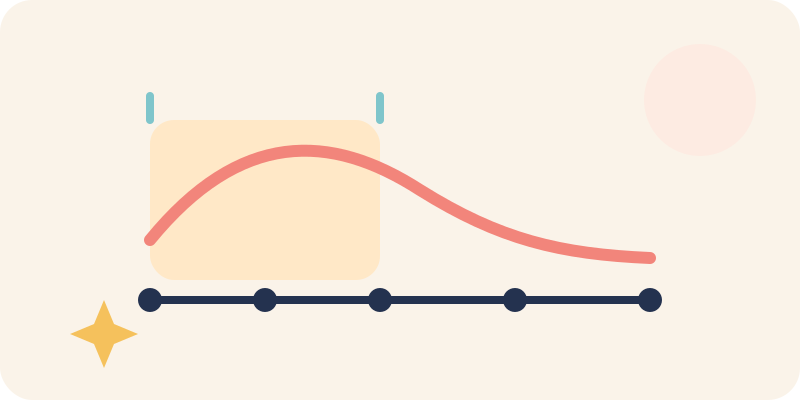
Sensitivity does not switch off like a light. It tapers gradually, so naming a hard age cut-off would make the phenomenon look sharper than it is.
So what happens once it passes?
The common account is that after a certain age nothing more can be done. That is a stronger claim than the evidence supports.
What declines is not the existence of plasticity but how easily it is obtained. The same change requires more repetition, more time and a more targeted stimulus.
Gains have in fact been reported in adults with amblyopia: dichoptic approaches that exercise both eyes together have shown that the adult brain can respond to this kind of training (Li et al., Current Biology, 2013).
The accurate framing is this: the early years are the most favourable window, not the only one.
What it means in practice
First, the screening schedule has a real justification behind it. Amblyopia caught early usually resolves faster and with less effort.
Second, a late diagnosis does not mean treatment is not worth attempting. Age is information used to set expectations and duration, not to rule treatment out.
Third, plasticity requires repetition. Short, regular sessions sustained over months are worth more than a plan that is perfect in theory and never carried out. Whether a method can actually be kept up is one of its most important properties.
Terms used here
- Critical period
- The developmental window in which the visual system is most open to experience and its connections are shaped by the incoming image.
- Monocular deprivation
- Depriving one eye of its image during development. It is the experimental method that established the existence of the critical period.
- Experience-dependent plasticity
- The reorganisation of neural connections according to incoming input. It is strongest during the critical period and declines afterwards without disappearing.
Sources
- Wiesel TN, Hubel DH. Single-cell responses in striate cortex of kittens deprived of vision in one eye. Journal of Neurophysiology. 1963;26:1003-1017. doi:10.1152/jn.1963.26.6.1003
- Li J, Thompson B, Deng D, Chan LYL, Yu M, Hess RF. Dichoptic training enables the adult amblyopic brain to learn. Current Biology. 2013;23(8):R308-R309. doi:10.1016/j.cub.2013.02.042