Learning Center
Guides on lazy eye, vision training at home, and the science behind Dichoptix.
Conditions
July 11, 2026
What is lazy eye (amblyopia)?
Lazy eye develops when one eye's vision doesn't get the support it needs. A short introduction: what it affects, the classic approaches, and dichoptic training that puts both eyes to work together.
July 25, 2026
The lazy eye guide: signs, causes and treatment options
Everything parents ask most, in one place: how to spot the signs early, what causes amblyopia, when it can be treated, and how patching, drops and dichoptic training compare.
July 27, 2026
Myopia, hyperopia and astigmatism: what each one means
What the three refractive errors actually are, which of them is most closely tied to lazy eye, and which ones change as a child grows.
July 27, 2026
Anisometropia: why a difference in prescription between the eyes matters
The most common and quietest cause of lazy eye: one eye needing a markedly stronger prescription than the other. Why it goes unnoticed, and why glasses alone may not be enough.
July 27, 2026
Strabismus and lazy eye: how the two connect
A squint does not always cause lazy eye, and lazy eye does not always come with a visible turn. Where the two conditions meet, and what surgery does and does not solve.
July 27, 2026
Deprivation amblyopia: when the image is blocked from the start
With a congenital cataract or a drooping eyelid, the image never reaches the retina at all. The rarest but most urgent form of amblyopia, and why it is a race against time.
July 27, 2026
Convergence insufficiency: the reason behind eyes that tire while reading
When the eyes struggle to turn inward for near work, reading becomes exhausting. How this often-misread picture shows itself, and how it differs from lazy eye.
July 27, 2026
Double vision (diplopia): why it happens, and why children rarely report it
When two images cannot be merged, the expected result is double vision. In adults it is the most distressing of complaints; in children it quietly turns into suppression instead.
July 27, 2026
Lazy eye in adults: is it really too late?
Adults with amblyopia were told for years that nothing could be done. Recent research softens that verdict: where the critical period idea comes from, what studies show about the adult brain, and where to start.
Diagnosis
July 27, 2026
When should a child's eyes be checked?
Amblyopia produces no complaint, so waiting for one achieves nothing. The checkpoints by age, and the signs that mean you should not wait for the next appointment.
July 27, 2026
What happens at your child's eye exam?
Many families put the exam off because the child seems to see fine, or because the visit feels daunting. Knowing what happens step by step makes it easier: the tests, the drops, and what to ask the doctor.
July 27, 2026
How visual acuity is measured, and what the numbers mean
What values like 20/20 or 6/12 actually tell you, how a child who cannot read yet is tested, and why each eye has to be measured on its own.
July 27, 2026
Depth and fusion tests: how the eyes' teamwork is measured
Reading letters on a chart does not measure two-eyed vision. Which tests assess depth perception and fusion at an exam, and what the results mean.
July 27, 2026
How suppression is detected: the methods used at an exam
Suppression produces no complaints and the child never notices it. So how does a doctor make it visible? From the cover test to filter-based tests, and why it is tracked during treatment too.
July 27, 2026
Dilating drops: why they are needed and how to prepare your child
A child's focusing power can hide their true prescription. The drops relax it temporarily. Why they matter, how long the effects last, and how to plan the day around them.
July 27, 2026
How to read an eyeglass prescription
SPH, CYL, AXIS, PD: what each column on the slip you leave the clinic with actually says, and which of the numbers matters for amblyopia.
Treatments
July 27, 2026
What is dichoptic training? How it differs from patching
Instead of working the weak eye alone, dichoptic training brings both eyes together on the same task. The logic of the method, how it differs from patching, and what the research says so far.
July 27, 2026
How do red-blue therapy glasses work?
The little glasses that look like a toy are actually a precise optical tool: they show each eye only its own share of the screen. The logic of the color filters, the system they form with a screen, and what families should know.
July 27, 2026
Can games treat lazy eye?
Skepticism about treating lazy eye with games is fair. The nuanced answer: the game itself heals nothing; what works is the visual task built into it. Where the science stands, and why not every game is therapy.
July 27, 2026
Can glasses alone treat lazy eye?
When amblyopia comes from an uncorrected focusing error, the first step is not a patch but the right pair of glasses. Here is how much correction alone achieves, and what the first months look like.
July 25, 2026
Why is eye patching so hard? Ways to make it easier
A child who refuses the patch isn't being difficult; they're facing a real difficulty. Where the resistance comes from, and practical ways to make everyday compliance easier.
August 12, 2026
How many hours of patching? What the literature says
Your doctor sets the time. This article covers the studies behind that decision: the trials that compared two hours with six, and why the total is discussed more than any single day.
August 12, 2026
Tracking patching: how do you know how much was done?
The hard part of patching is not prescribing it, it is knowing whether it happened at home. Why a paper diary is not enough, and what objective tracking changes.
July 27, 2026
Atropine drops: the alternative to the patch
Atropine blurs the strong eye's near vision for a few days, pushing the weaker eye forward. How it works, what the trials comparing it with patching found, and what it looks like day to day.
July 27, 2026
What strabismus surgery does, and what it does not
Surgery straightens the eyes; it does not raise the vision in the weaker one. How it relates to amblyopia treatment, why the order matters, and what carries on afterwards.
July 27, 2026
The evolution of amblyopia treatment: what was added alongside patching
From a two-hundred-year-old idea, to understanding that the brain learns to suppress, to digital treatments that work both eyes together: a short history of what the field added to its toolkit.
July 27, 2026
After treatment: do the gains hold, and can it regress?
Vision improved, so what now? Why treatment is not stopped abruptly, what the maintenance phase is for, and how regression is spotted.
Exercises
July 27, 2026
Which kind of work targets which visual skill?
In vision training each type of work touches a different skill: acuity, alignment, fusion, depth, tracking. Knowing what targets what makes your treatment plan far easier to read.
July 27, 2026
Classic orthoptic exercises: the Brock string, pencil push-ups and the rest
Brock string, Marsden ball, pencil push-ups: what these classic exercises target, how they differ from dichoptic work, and when they are used.

July 27, 2026
Doing vision exercises safely at home: what to watch for
Vision exercises are safe, but not unlimited. When to stop, which signs to report, and why exercises found online should not be started on your own.
For families
July 27, 2026
Just told your child has lazy eye: what to do in the first week
The moment of diagnosis catches most families off guard. The concrete steps to take without panicking, the questions to ask the doctor, and the routine to set up in week one.
July 27, 2026
How to explain lazy eye to your child
A good explanation is the strongest support a months-long treatment can have. Age-appropriate wording, phrases to avoid, and what to tell siblings and classmates.
July 27, 2026
A vision training roadmap: what to expect week by week
The hardest part of a months-long process is the uncertainty. The typical phases of a vision training program, why plateaus are normal, and why the real milestones are the check-ups.
July 27, 2026
Setting up home sessions: distance, light and timing
A session's yield depends not just on the game but on the quality of the setup: a practical checklist for seating and distance, room light, glasses order, timing and distractions.
July 27, 2026
Keeping motivation up through months of treatment
The hard part of vision therapy is not the first week but the third month. What actually keeps a family going once the novelty is gone, and what does not work.
July 27, 2026
Does lazy eye affect reading and school?
Amblyopia is not a learning difficulty, but it can show up in reading and in hand-eye tasks. Where it has an effect, where it does not, and what helps in the classroom.
July 27, 2026
Talking to school and teachers: what helps in the classroom
A teacher who knows provides both practical help and social cover. What to tell them, which small adjustments work, and how to read feedback about school performance.
July 27, 2026
Screen time worries: is the therapy screen harmful too?
For families who have spent years limiting screens, a daily therapy session on a screen feels contradictory. What is known in the screen time debate, and how a therapy session differs.
July 27, 2026
Lazy eye: myths and facts
Eating carrots, sitting too close to the television, growing out of it: which common beliefs hold up and which do not? The ten sentences you hear most, examined.
July 27, 2026
The 45 questions families ask most
From diagnosis to treatment, school to daily life: short, clear answers to the questions that come up most at an exam, with links to the fuller articles.
Vision science
July 27, 2026
Binocular vision: how two eyes build one picture
Seeing well is more than one eye's sharpness. How the two eyes work as a team, which everyday skills that teamwork produces, and where amblyopia fits into the system.
July 27, 2026
The visual cortex: where seeing actually happens
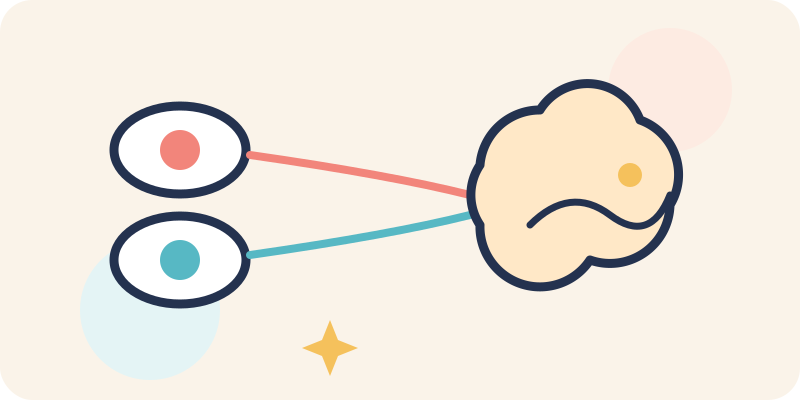
The eyes collect the image, but seeing is built in a region at the back of the head. The path the signal takes, what the cortex does with it, and why amblyopia is a brain topic.
July 27, 2026
Vergence: how the eyes adjust together for near and far
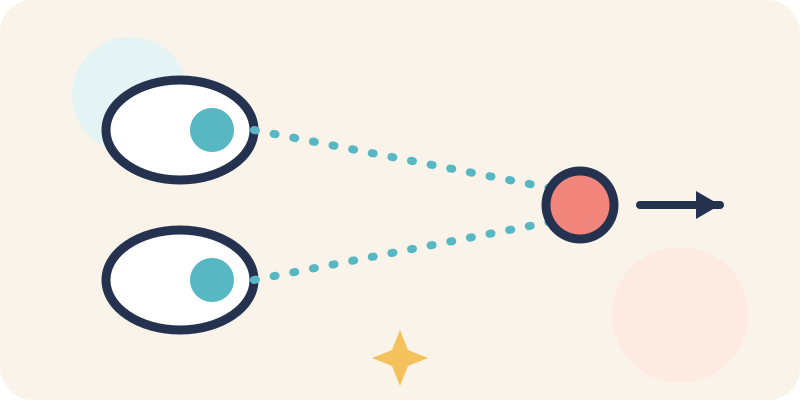
Look up from a book to the window and your eyes silently change their alignment. How that skill works, the complaints it produces when it struggles, and how it relates to amblyopia.
July 27, 2026
Fusion: how the brain turns two images into one
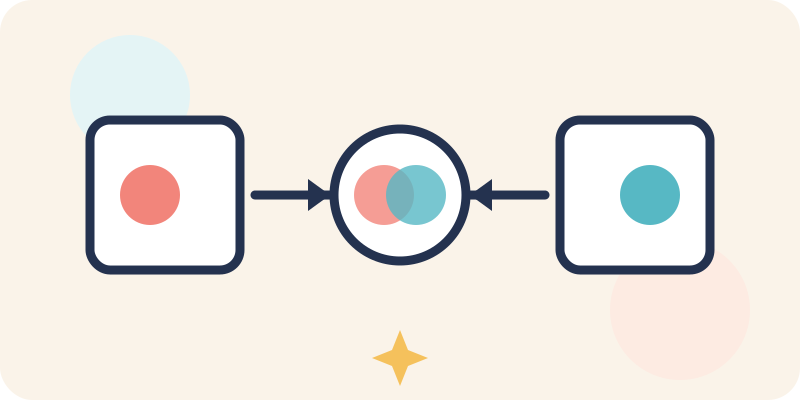
Two eye images becoming a single scene is not automatic; it is a learned and fragile skill. The steps of fusion, and why it is among the first things lost in amblyopia.
July 27, 2026
Stereopsis: how depth perception is built, and what its loss costs
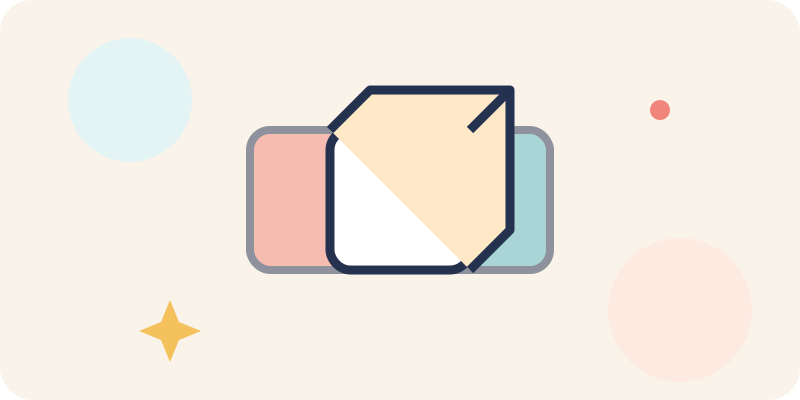
Three-dimensional vision is born from the small difference between the two eyes' viewpoints. How the skill is built, where it shows up in daily life, and why amblyopia hits it especially hard.
July 27, 2026
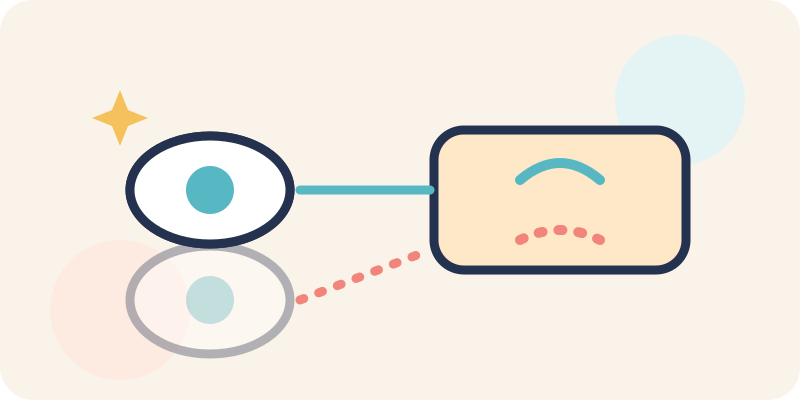
Suppression: why the brain ignores one eye
The unseen half of amblyopia: faced with two conflicting images, the brain learns to push one aside. Why that is a clever solution, why it later becomes the problem, and how treatment targets it.
July 27, 2026
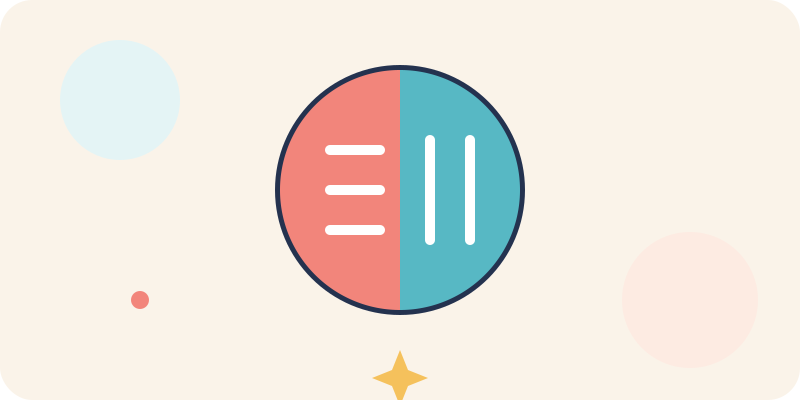
Binocular rivalry: what happens when each eye sees something different
Give the brain two images it cannot merge and something odd happens: perception alternates between them. This lab finding is the key to understanding suppression and the logic of dichoptic treatment.
July 27, 2026
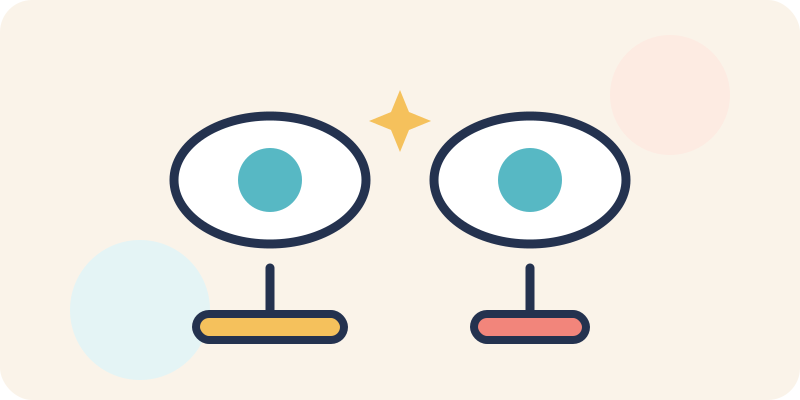
Eye dominance: what a dominant eye is, and why it is not lazy eye
Everyone has a dominant eye and that is entirely normal. The difference between dominance and the suppression of amblyopia, what the simple home test actually shows, and where it gets misread.
July 27, 2026
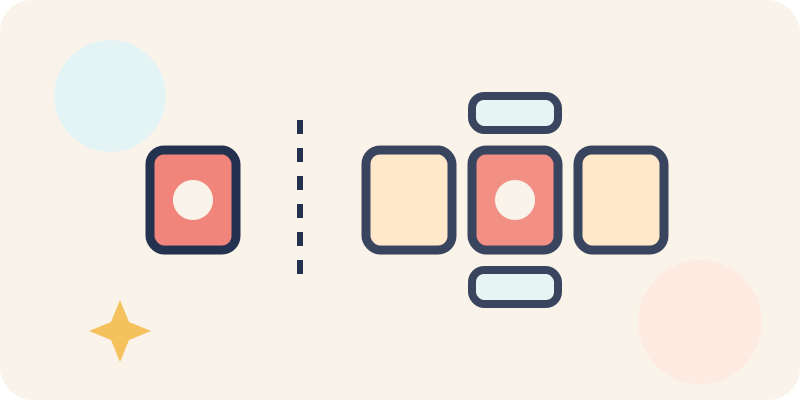
Crowding: one letter is readable, a row of them is not
The most characteristic feature of an amblyopic eye is not blur but the way objects run together when they sit side by side. Why that happens, and what it costs in reading.
July 27, 2026
Contrast sensitivity: the vision the chart does not measure
The eye chart measures the smallest black letter on white. Life is rarely that crisp. What contrast sensitivity is, and why dichoptic training works on exactly this axis.
July 27, 2026
Fixation instability: the gaze is never truly still
Even while holding a target, the eyes are in constant small motion. In an amblyopic eye that motion is larger, and it leaves traces in reading, acuity and how the two eyes coordinate.
July 27, 2026
The critical period: the years vision is built in
There is a reason age comes up in every conversation about amblyopia. What the developmental window is, and what actually happens once it narrows.
July 27, 2026
Neuroplasticity: how the brain relearns to see
The mechanism underneath vision training: the brain's ability to reshape itself with experience. How it works, why it is faster in childhood, and why regular repetition is non-negotiable.
For clinicians

July 28, 2026
The evidence for dichoptic treatment: where we stand today
A summary for clinicians: the pivotal randomised trials, the head-to-head comparison with patching, and the adherence data. The decisive finding is that the same principle ran at 46% adherence as a single game and 91% as rich video content.
July 27, 2026
Patient selection and follow-up in dichoptic treatment: a practical frame
For clinicians: which patients a binocular approach suits, what to assess at baseline, which measures to track in follow-up, and when to revisit the plan.
July 27, 2026
Outcome measures in amblyopia: what to track, and when
Visual acuity is not the whole of follow-up. Which measure answers which question, the errors that destroy comparability, and what to track in a dichoptic program.