Anisometropia: why a difference in prescription between the eyes matters
Published: July 27, 2026
In short
In anisometropia one eye sees sharply and the other blurred, and the brain pushes the blurred one aside. With no visible sign it is usually caught only at an exam; glasses are the essential first step, but once suppression has set in they may not be enough on their own.
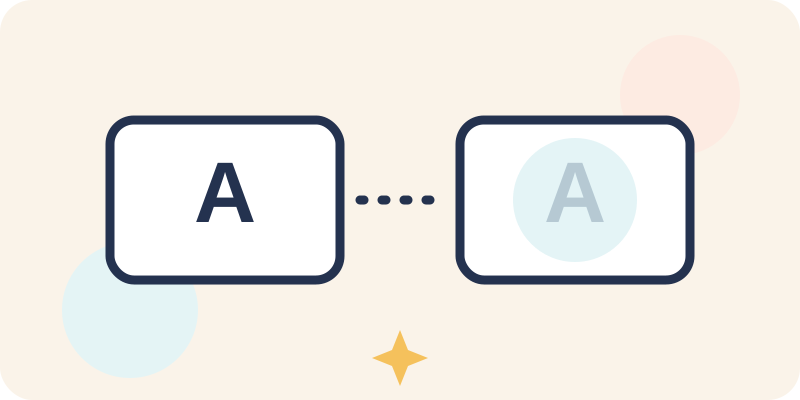
One of the most common causes of lazy eye is also the quietest: a difference in prescription between the eyes. Medically it is called anisometropia, and it is something no onlooker could ever spot.
This article covers why the difference matters so much, why it slips past everyone, and how it is handled in treatment.
Why does a difference cause trouble?
If one eye needs a markedly stronger prescription, the image landing on that eye's retina is permanently blurrier. Meanwhile the brain is trying to merge the two views.
Since a sharp image and a blurred one cannot be merged, the brain takes the practical way out and pushes the blurred one into the background. That is how suppression begins, and in time that eye's visual development falls behind.
The larger the difference and the longer it goes uncorrected, the higher the risk is known to be.
Why does it go unnoticed?
Because there is no visible sign at all. There is no turn as in strabismus and the child does not complain; seeing the world sharply through the better eye, nothing seems wrong to them.
Families rarely sense a problem either: the child watches television, reads a book, runs and plays. The issue only surfaces when each eye is measured separately.
That makes routine eye exams, done without waiting for complaints, almost the only way to catch anisometropia.
Why are dilating drops needed?
A child's focusing power is very strong, and it can mask an existing prescription during an exam. The child may push through and read the chart, so the prescription measures lower than it really is.
The drops relax that focusing temporarily and make the true prescription visible. Anisometropia is precisely the kind of finding that an exam without drops can miss.
How is it handled in treatment?
The first and non-negotiable step is the right glasses: until the difference is corrected, no other method works properly, because as long as the blur persists so does the brain's reason to suppress.
For some children, glasses with follow-up are enough. But where suppression has taken hold, the brain can keep discounting that eye even once the image is sharp, and that is where approaches that work both eyes together come in.
Your doctor decides based on the size of the difference, the child's age and how deep the suppression runs.
Terms used here
- Anisometropia
- A marked difference in refractive error (prescription) between the two eyes.
- Refractive error
- The eye not focusing light exactly on the retina; short sight, long sight and astigmatism belong to this group.
- Cycloplegic exam
- An exam using drops that temporarily relax the eye's focusing power, so the true prescription can be measured.