Suppression: why the brain ignores one eye
Published: July 27, 2026
In short
Suppression is not a fault but a clever way out the brain finds to resolve a conflict. The trouble is that the temporary fix hardens into a habit, which is why modern treatment targets the suppression itself, not just the weaker eye.
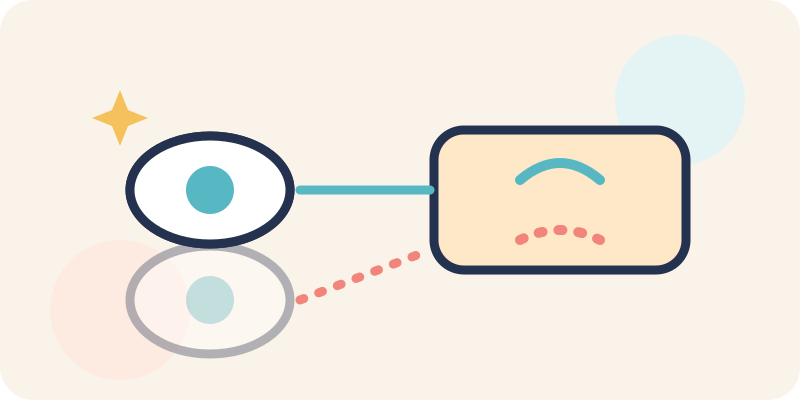
The first thing that comes to mind with amblyopia is one eye seeing less. But there is a less-discussed half of the problem, arguably the more important one for treatment: the brain learning to actively push that eye's information into the background. This is called suppression.
This article covers why suppression appears, why it is a clever solution at first, and why in time it becomes the core of the problem.
The conflict the brain has to resolve
The brain is built to merge the images from both eyes. So what happens when those two images do not agree? One eye may be sharp while the other is markedly blurred, or one eye may be pointing in a slightly different direction.
Merging is then impossible, and two uncomfortable consequences follow: a picture smeared with blur, and double vision. The brain resolves the mess in the most practical way available, by turning down the weight of the problematic signal.
What suppression is, and what it is not
The brain does not switch that eye off; the eye keeps seeing and keeps sending signals. What changes is how much of that information reaches conscious perception. An analogy: if two people give you directions at once and one of them keeps garbling the words, you soon stop listening to that one and focus on the clear voice.
Suppression is therefore not a fault but an adaptation. In the short run it works: the child does not see double, does not get headaches, feels fine. That is also what makes it invisible; the child voices no complaint, because as far as they are concerned nothing is wrong.
Why the temporary fix becomes a lasting problem
The brain strengthens the connections it uses often and weakens the ones it uses rarely. When the suppressed eye's signal stays permanently in the background, that pathway's representation in the brain never gets its chance to develop. Visual acuity falling behind is the result.
The second loss is quieter: because the eyes no longer work together, fusion and depth perception cannot develop either. This is why amblyopia is not only one eye seeing less but also a loss of two-eyed vision.
How deep suppression runs varies from person to person: for some it appears only under certain conditions, for others it is near constant.
How does treatment target it?
Putting suppression at the center changes the goal of treatment. Covering the strong eye does exercise the weaker one, but while the patch is on, the two eyes never work together for a moment, so the habit of suppression is not addressed directly.
Dichoptic training enters exactly here: each eye is shown a different part of the same scene, and the task can only be completed if the two parts merge in the brain. Lowering the contrast of what the strong eye receives brings the weaker eye's signal forward, with the aim of getting the brain to take it into account again.
The next article takes on the skill suppression damages most: depth perception.
Terms used here
- Suppression
- The brain largely removing one eye's image from conscious perception; it does not switch the eye off, it gives its signal less weight.
- Diplopia
- Seeing one object as two separate images, double vision.
- Visual acuity
- How much fine detail an eye can resolve, measured with a chart at an exam.