Binocular vision: how two eyes build one picture
Published: July 27, 2026
In short
The eyes collect the image; the brain builds the seeing. Working together gives the eyes fusion and depth perception, and amblyopia is a problem of that shared system rather than of one eye alone.
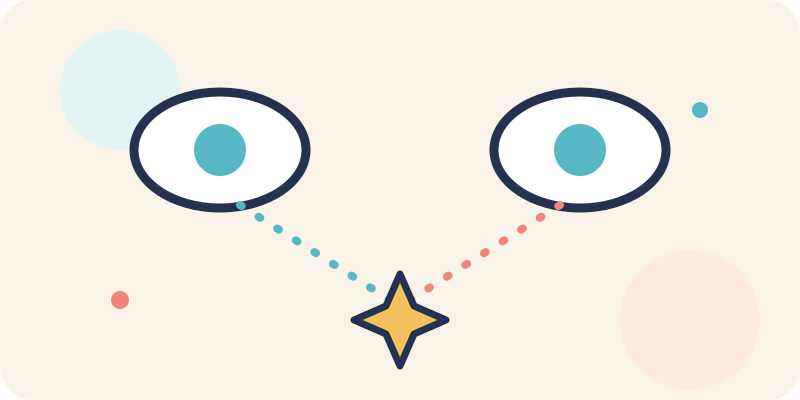
We usually reduce vision to a single question: can you read the smallest line on the chart? Yet seeing well in daily life is more than that. Judging the distance as you reach for a glass, knowing where the step ends on the stairs, reading without losing your line: all of it rests on the two eyes working together.
This article is about how that teamwork is built. The soundest route to understanding amblyopia is to see first how healthy binocular vision works.
The eye looks, the brain sees
The eye works roughly like a camera: light passes through the clear front layer (the cornea), is focused by the lens, and lands on the light-sensitive layer at the back (the retina). The retina turns that light into electrical signals and sends them to the brain through the optic nerve.
Seeing itself happens in the brain, in the visual cortex at the back of the head. The eye collects the image; the brain builds the seeing. This is the key to why, in amblyopia, the problem lies not in the eye itself but in the learning process between eye and brain.
Why two images become one
Your eyes sit a few centimeters apart, so they look at the world from slightly different angles. You can test it: hold a finger a hand's width in front of your nose, then close one eye and the other in turn. The finger appears to jump.
Rather than stitching those two views side by side, the brain merges them into a single scene, a process called fusion. The small angular difference is not thrown away: the brain converts it into depth information. The eyes' small disagreement is the source of the third dimension.
What binocular vision gives you
Stereopsis, or depth perception: judging at a glance how far away things are. Catching a ball, pouring water into a glass and walking down stairs all depend on it.
A wide, seamless field of view: because the two eyes' fields combine, you take in more of your surroundings at once.
Visual stamina: with two eyes sharing the load, long reading and close work are less tiring.
Redundancy: when one eye is briefly blocked by an eyelash or a reflection, the scene does not cut out; the other eye carries it.
Three conditions the system needs
First, both eyes must see clearly enough: if one eye's image is markedly blurry, the brain cannot merge the two views cleanly.
Second, both eyes must be able to point at the same spot: when alignment is off (strabismus), two conflicting scenes reach the brain.
Third, the brain must have learned to process and combine the two signals, a learning that is laid down in the early years of childhood when the visual system is at its most flexible.
When one of these conditions fails, the brain finds a way out and starts giving less weight to the weaker signal. That mechanism sits behind amblyopia, and it is the subject of the next article.
Why does this matter for treatment?
Define amblyopia only as one eye seeing less, and treatment shrinks to exercising that eye alone. Seen through the lens of binocular vision, the goal changes: getting the two eyes to work together again.
That is the starting point of modern dichoptic approaches, and it explains why gains like depth perception are discussed as a target in their own right.
Terms used here
- Binocular vision
- The images from both eyes becoming one single, whole picture in the brain.
- Fusion
- The brain's work of merging the two eye images into one.
- Stereopsis
- True depth and 3D perception, born from the small difference between the two eyes' viewpoints.
- Visual cortex
- The vision center at the back of the brain where signals from the eyes are processed.