Vergence: how the eyes adjust together for near and far
Published: July 27, 2026
In short
Vergence is the eyes adjusting alignment for distance, and it is the precondition for fusion. When it struggles it causes fatigue, headaches and reading difficulty; in amblyopia, broken alignment can be the first link in the chain that triggers suppression.
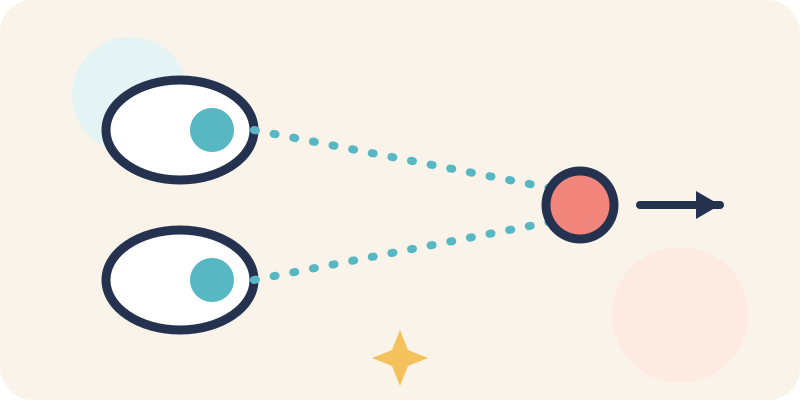
When you lift your head from a book and look out of the window, your eyes do two things: they refocus and they change their alignment. The second is called vergence, and because it works unnoticed it is almost never discussed.
This article covers how vergence works, which complaints it produces when it is under strain, and how it connects to amblyopia.
Why near work takes extra effort
Looking into the distance, the two eyes' lines of sight are nearly parallel. As an object comes closer those lines have to cross, which means the eyes must turn inward; that is convergence. When the object moves away, the adjustment runs the other way.
This adjustment travels with focusing: the lens changes shape to sharpen the image (accommodation) while the eyes change alignment. The two systems are linked, so strain in one shows up in the other.
You can watch it in yourself by slowly bringing a finger toward your nose: past a certain point you can no longer hold a single image and the finger doubles. That point is the limit of vergence.
Why vergence is the precondition for fusion
For the brain to merge two images, the eyes have to be pointing at the same spot. Without alignment there is no clean data to merge.
Vergence is therefore the first link in the fusion chain: the motor part happens here, the sensory part happens in the brain.
What it looks like under strain
When the vergence system is strained, complaints usually surface during near work: tired eyes while reading, headaches, skipping lines, letters starting to drift or double after a while, and avoiding reading altogether.
In children this picture often looks less like a vision problem than like an attention or motivation problem. Feedback from school about a child who does not focus sometimes has this behind it.
Convergence insufficiency is the best-known presentation in this area, and it is assessed at an eye exam.
How it relates to amblyopia
If the eyes are permanently misaligned (strabismus), the brain receives two conflicting scenes and usually suppresses one of them. An alignment problem can therefore be the start of the chain that leads to suppression and amblyopia.
The reverse holds too: when one eye is suppressed, the feedback that lets the eyes adjust together weakens, and vergence performance suffers with it.
This is why work that brings both eyes onto the same task targets not only sharpness but the eyes' ability to operate as a team.
Terms used here
- Vergence
- The two eyes turning toward or away from each other according to how far the target is.
- Convergence
- The eyes turning inward when looking at something near.
- Accommodation
- The lens of the eye changing shape to bring a near object into focus.